Insulation Materials
Spray Polyurethane Foam: Thermal Properties and Practical Considerations
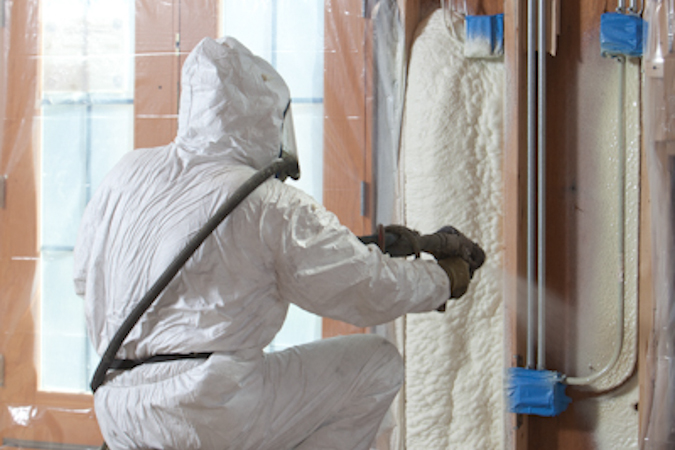
Spray polyurethane foam (SPF) is produced by mixing two liquid components — a polyol and an isocyanate — at the point of application. The reaction causes the mixture to expand rapidly, filling cavities and adhering to the substrate to form a continuous insulating layer. The resulting foam exists in two main forms: closed-cell and open-cell, with substantially different properties that determine appropriate applications.
Among commonly available insulation materials, closed-cell spray PU foam achieves the lowest declared thermal conductivity, enabling the same thermal resistance to be achieved at considerably reduced thickness compared to mineral wool or EPS. This characteristic makes it relevant in renovation contexts where available depth for insulation is constrained.
Closed-Cell vs Open-Cell Foam
Closed-Cell SPF
In closed-cell foam, the gas bubbles produced during the reaction remain sealed within the polymer matrix. This gives the material its characteristic rigidity, high density (typically 30–80 kg/m³), low moisture permeability (very low water vapour diffusion resistance μ values of 50–200), and superior thermal conductivity.
Closed-cell SPF achieves declared thermal conductivity (λD) values of 0.022–0.028 W/(m·K), depending on the specific formulation, blowing agent, and product certification. This represents a significant advantage over mineral wool and standard EPS when insulation depth is limited. The material also functions as an air barrier and, to a degree, as a vapour retarder — characteristics that affect how the surrounding construction must be detailed.
Open-Cell SPF
Open-cell foam has a more porous structure where the cell walls are ruptured during expansion, allowing air to fill the void space. The resulting material is soft, lightweight (typically 8–16 kg/m³), and highly permeable to water vapour. Thermal conductivity for open-cell SPF is substantially higher than closed-cell, typically 0.035–0.040 W/(m·K), placing it in the same range as mineral wool or EPS. Open-cell SPF is less commonly used in Poland for thermal insulation due to its limited thermal advantage and moisture permeability, which requires careful vapour control detailing in cold climates.
Thermal Performance Data
Application Methods and Constraints
Unlike board or roll insulation, spray PU foam requires specialised equipment and trained applicators. The two-component system is stored in pressurised tanks and mixed through a heated proportioning machine. Application temperature constraints are significant: substrate and ambient temperatures must typically be within the range of 10–35°C for the reaction to proceed correctly, and the substrate must be dry and free from frost.
This makes spray application impractical during Polish winters without heated enclosures, limiting the seasonal window for application in unheated buildings. In renovation contexts where work must occur in colder months, board-form rigid PU insulation (factory-produced PUR or PIR boards) offers an alternative with similar thermal conductivity that can be installed at lower temperatures.
Applications in Polish Construction
Spray PU foam is used in several specific contexts in Polish buildings:
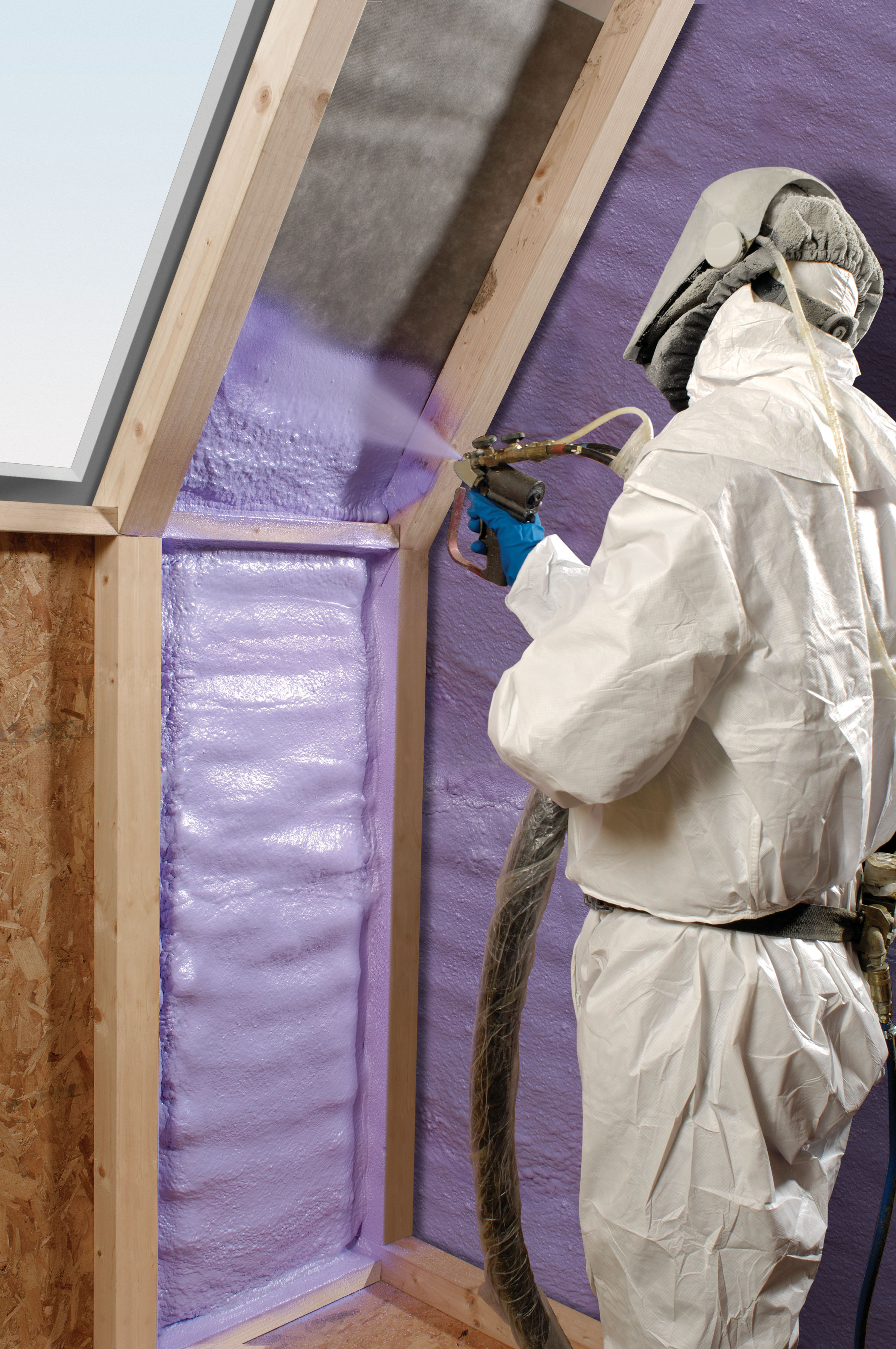
- Pitched roof insulation from below, applied directly to the underside of roof decking where rafter depth is insufficient for adequate mineral wool thickness
- Sealing of junctions, penetrations, and structural nodes in the insulation envelope
- Insulation of irregularly shaped elements — pipe supports, structural brackets, curved surfaces
- Retrofitting of flat roofs where the system requires a continuous, seamless layer with integrated air sealing
- Industrial applications — cold storage, process plant insulation, tank insulation
It is not commonly used as the primary insulation material in ETICS facade systems in Poland, where EPS and stone wool boards dominate due to established installation practice, supply chain depth, and the compatibility requirements of render systems certified under ETA (European Technical Assessment).
Fire Classification
Polyurethane foam is a combustible material. Without fire retardants, it can be classified at Euroclass E or F under EN 13501-1. Most construction-grade closed-cell SPF products used in Poland include fire retardants that improve the classification, with some products reaching B-s2,d0 or C-s2,d0. However, the classification applies to the material as tested; the performance in an actual building depends on how the foam is protected. Building regulations in Poland require that combustible insulation in certain positions, particularly below roof claddings, is protected by a fire-retarding layer or cover board.
For non-combustible insulation requirements — particularly in buildings over 25 metres or in compartment separating elements — mineral wool remains the appropriate material choice.
Vapour and Air Barrier Properties
Closed-cell SPF has a water vapour diffusion resistance factor (μ) of approximately 50–200, compared to 20–100 for XPS and 30–70 for EPS. This means that a closed-cell SPF layer can function as both the insulation and the vapour retarder in a roof or wall assembly, potentially eliminating the need for a separate vapour control layer. This simplification can be significant in renovation contexts where access for vapour barrier installation is limited.
The continuous adhesion of spray foam to substrates and around penetrations also provides inherent air sealing — a property that board insulation cannot replicate without additional taping and sealing of joints.
Cost Considerations
Closed-cell SPF has a higher material cost per m² than EPS or mineral wool, and the installation requires qualified contractor services with specialised equipment. In contexts where its specific properties — high resistance per millimetre, air sealing, or application to irregular surfaces — are genuinely necessary, the cost premium may be justified. In standard external wall applications where mineral wool or EPS would perform adequately, the additional cost is generally not warranted.
For comparison with board-form insulation materials, see the overview of EPS vs XPS polystyrene and the mineral wool guide.